The foundations of York Minster rest upon nearly two millennia of continuous occupation. Long before the present cathedral rose above the city, the site was dominated by the Roman fortress of Eboracum, one of the most significant military installations in northern Britain.
The Founding of Eboracum
Roman general Quintus Petillius Cerialis and the Ninth Legion established the military fortress of Eboracum in 71 AD. The site, on flat ground above the River Ouse, was selected for its strategic command of northern Britain. The original defences were turf ramparts set upon green wood foundations, constructed between 71 and 74 AD. These early earthworks marked the beginning of a Roman presence that would shape the settlement for centuries.
From Timber to Stone
The fortress covered approximately 50 acres and measured 474 by 403 metres, large enough to accommodate a legion at full strength of roughly 5,500 men. The wooden camp was refurbished by Agricola in 81 AD and entirely rebuilt in stone between 107 and 108 AD. The Sixth Legion later assumed garrison duty, possibly as early as 118 AD. By 237 AD, Eboracum had achieved the status of a colonia, the highest legal designation available to a Roman city.
Imperial Power in the North
Eboracum served as the major military base in northern Britain and, following the third-century division of the province, became the capital of Britannia Inferior. The fortress was the scene of profound imperial events: Emperor Septimius Severus died there in 211 AD, and Emperor Constantius Chlorus died there in 306 AD. In the latter year, troops in the fortress proclaimed Constantine I as emperor, an act that would reshape the Roman world. The name Eboracum derives from the Common Brittonic *Eburākon, possibly meaning "yew tree place".
The Principia Beneath the Transept
Archaeological evidence indicates that the Roman principia, the military headquarters, was located partly beneath the post-1080 Minster site. The first recorded church on the Minster site, a wooden structure built in 627 AD, probably stood in or beside the old Roman principia. This continuity of administrative and sacred use across more than a thousand years is one of the defining characteristics of the location. The medieval walls of the Minster incorporate remnants of the original Roman fortifications.
Archaeological Discovery
Between 1967 and 1973, excavations beneath the south transept uncovered the remains of the north corner of the Roman principia. These investigations confirmed the extent to which the cathedral had been constructed directly over the heart of the Roman military establishment. The reconstruction of the south-west front of the fortress, with its polygonally-fronted interval towers and corner towers, is likely to have been carried out during the reign of Constantine. More than 48,000 cubic metres of Magnesian Limestone, quarried near Calcaria (present-day Tadcaster), were used in the stone rebuilding of the fortress.
What Visitors Can See Today
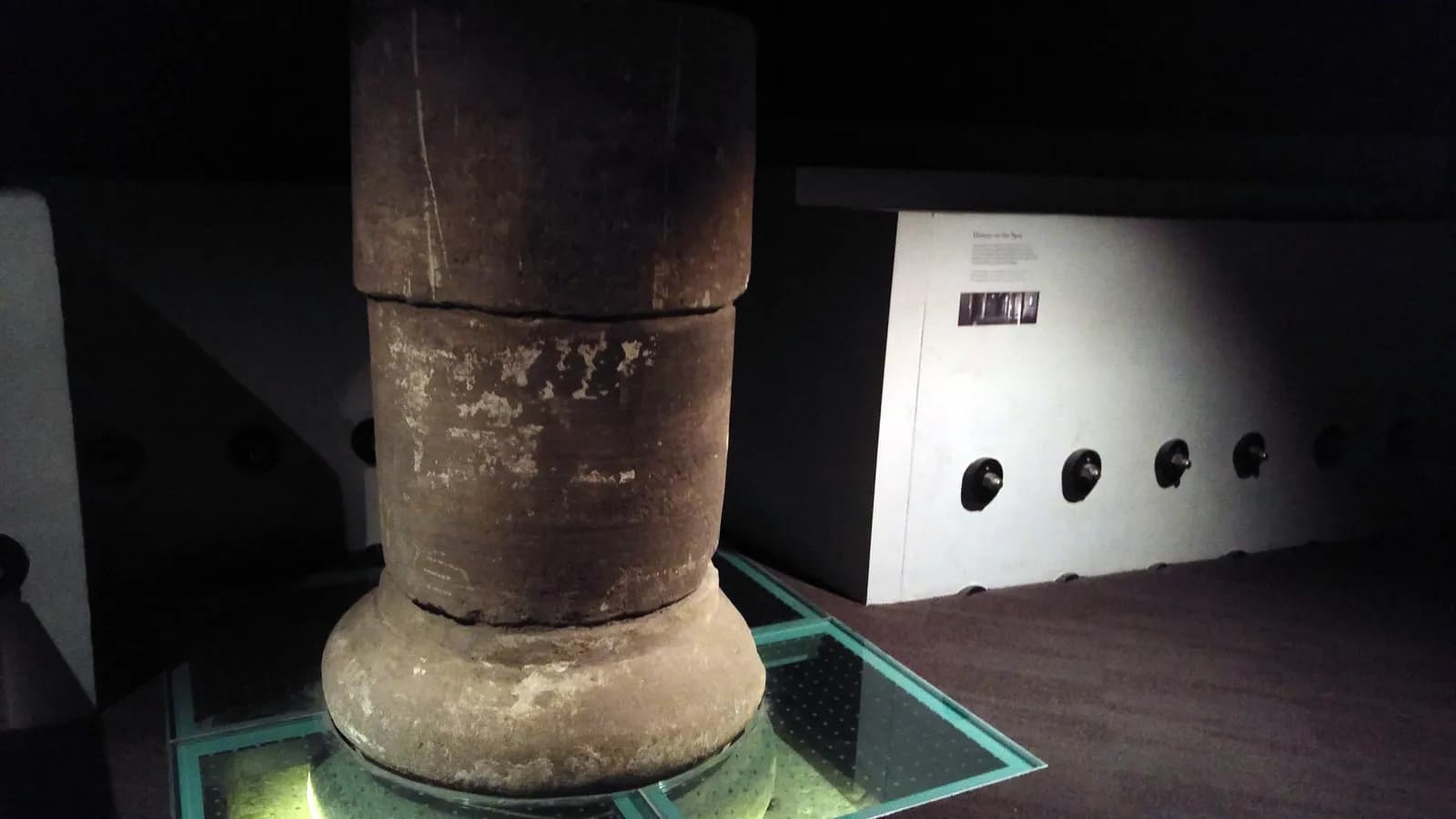
In spring 2013, the area beneath the south transept reopened to the public as part of a new exhibition exploring the history of York Minster's construction. Among the remains on display is a Roman column preserved within the Undercroft, a tangible fragment of the fortress that once commanded the site. The exhibition traces the site's evolution from Roman military headquarters to medieval cathedral.