York's most famous thoroughfare traces its origins to the Domesday Book and has transformed from a medieval meat market to a global tourist destination.
A Name That Tells the Story
The word "shambles" derives from the Old English sċeamol, meaning a bench or stall. By 1426, the street was recorded as "Great Flesh Shambles", later shortened to "The Shambles". The name refers to the wooden shelves, or shammels, where medieval butchers displayed their meat. The Anglo-Saxon term fleshammel describes these platforms, which lined the street for centuries.
Medieval Engineering
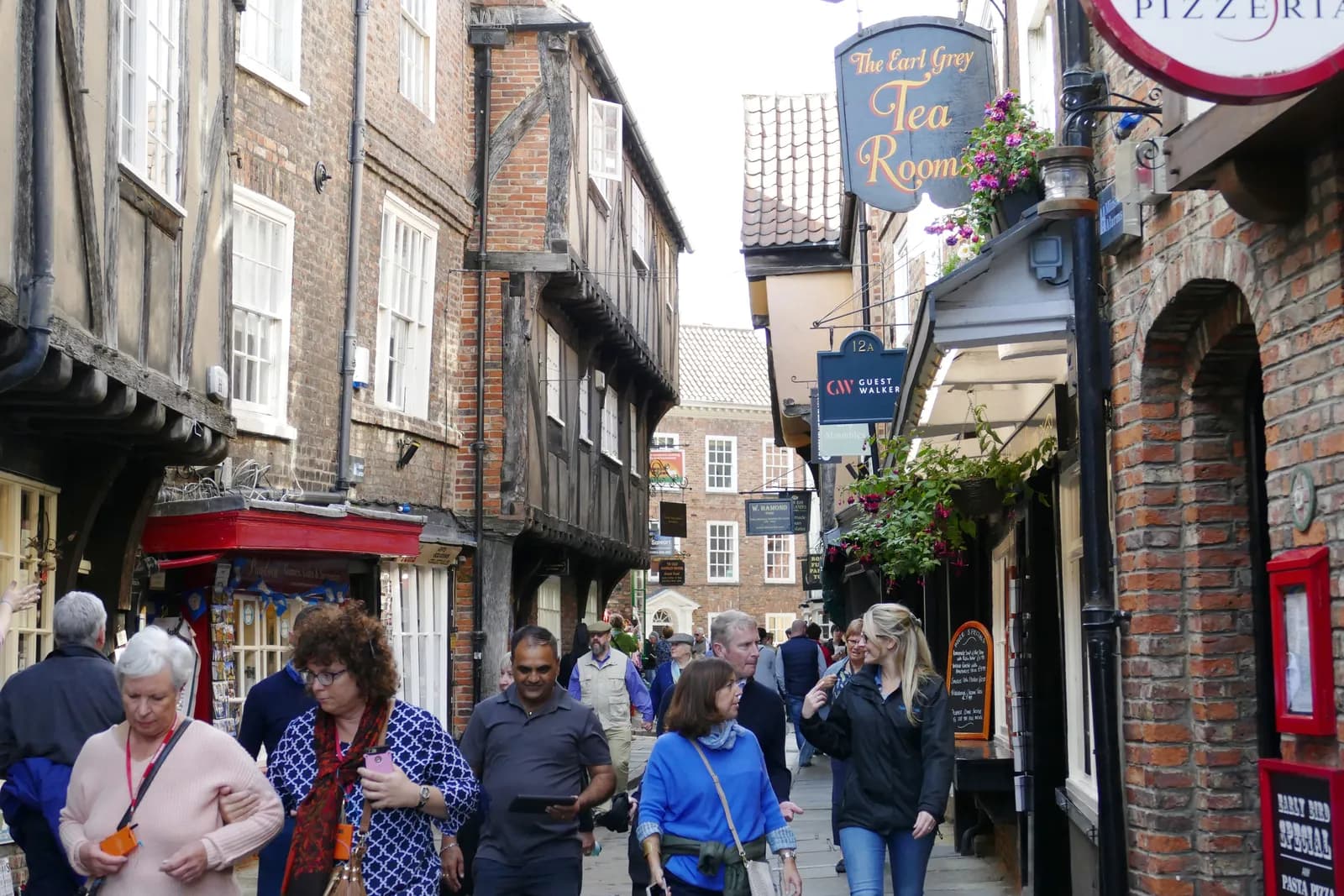
The Shambles stretches approximately 120 metres, lined with timber-framed buildings constructed largely between 1350 and 1475. The most striking feature is the jettied upper floors that overhang the street, some so close that a person with outstretched arms could touch both sides simultaneously. This design served practical purposes: the overhangs shaded meat from sunlight and protected the wattle-and-daub walls beneath.
A cobbled central channel, or runnel, ran the length of the street. Butchers washed blood, offal and waste into this channel twice weekly, creating the "river of blood" that gave the street its grim nickname. The natural slope of the street helped rainwater carry away the waste. Slaughterhouses operated behind the shop fronts, completing an ecosystem dedicated to meat production.
The Butchery Trade
Butchers occupied The Shambles for over 900 years. By 1798, nineteen butchers operated here from a total of eighty-eight across the city. The number peaked at thirty-one in 1885. The last butchers closed in the early twentieth century, leaving behind hooks, meat shelves and ghostly echoes of the trade.
Saint Margaret Clitherow
Number 10–11 The Shambles was home to Margaret Clitherow, "The Pearl of York". Born in 1553, she was the wife of a Protestant butcher but secretly practised Catholicism during a period of persecution. She sheltered priests in her home, which contained a concealed fireplace serving as a priest-hole. Clitherow refused to enter a plea at her trial and was executed in 1586. Canonised in 1970, she remains one of York's most significant religious figures. The shrine at number 35, opposite her former home, preserves this history.
Conservation and Restoration
The Shambles Area Committee, established in 1939 under John Bowes Morrell of the York Civic Trust, began a campaign to preserve the street. York City Council purchased properties and undertook major restoration in the 1940s and 1950s. Some buildings were extensively rebuilt, a decision that modern conservationists might question. The adjacent Little Shambles was demolished entirely, and the Butchers' Guildhall behind the houses did not survive. Today, almost every building on the street carries Grade II or Grade II* listed status.
The Diagon Alley Myth
In May 2017, the first Harry Potter-themed shop opened on The Shambles. Within seventeen months, three more followed. The street became associated with Diagon Alley, the wizarding shopping district in J.K. Rowling's novels. Tourists arrived in increasing numbers, queues formed outside the shops, and the narrow thoroughfare faced new pressures.
However, in May 2020, Rowling explicitly stated on Twitter that she had never visited The Shambles and that it did not inspire Diagon Alley. "I've never seen or been to the Shambles," she wrote. "Neither was based on any real place." The myth persists despite this clarification, demonstrating the power of association over fact.
The Shambles Today
The street now houses restaurants, bookshops, chocolatiers and jewellers alongside the wizard-themed shops. No butchers remain. Some locals have criticised the "Disneyfication" of the historic street, describing the Harry Potter shops as "commercialised tat" that prioritises cash over authenticity. Others argue that the income sustains preservation efforts.
The Shambles Market, renamed from Newgate Market in 2015, adjoins the street. The area remains one of York's most visited attractions, drawing millions among the city's annual tourists.
What Remains
Despite centuries of change, The Shambles retains its medieval character. The jettying, the cobbled street and the narrow passage transport visitors backwards. Number 1 Shambles retains its fourteenth-century dragon-beam. Numbers 31–33, built circa 1436, survive among the earliest structures. The meat-hooks and shammels on some shop fronts recall the butchers who worked here for nine centuries.
The street tells a layered story: Roman foundations, Domesday butchers, Reformation martyrs, Victorian commerce, post-war conservation and twenty-first-century tourism. The Shambles is not a museum piece but a living thoroughfare, adapting to each era while carrying its history forward.