The York Mystery Plays represent one of England's most remarkable theatrical traditions: a cycle of 48 biblical dramas performed on wheeled pageants that once paraded through the city's streets. First recorded in 1376, these plays emerged from the Corpus Christi festival and were suppressed in 1569, only to be revived in the 20th century as a cornerstone of York's cultural identity.
The Medieval Origins
The York Mystery Plays were firmly established by 1376, when records show pageant wagons already formed part of the Corpus Christi celebrations. The manuscript, dating from between 1463 and 1477, survives intact at the British Library. The cycle comprises 48 individual pageants (some sources suggest up to 56), each presenting a biblical story from the Creation through to the Last Judgment. One of only four virtually complete surviving English mystery play cycles, the York collection is distinguished by the work of the so-called "York Realist," who penned eight Passion plays noted for vigorous alliterative verse and subtle characterisation. Playwright Peter Gill once observed that this figure's influence was so profound that, without him, "Shakespeare would have been a second rate writer like Goethe."
The Wagon Pageant Tradition
The plays' unique format involved processional performance through York's streets. Each play was organised, financed and performed by a craft guild, from which the term "mystery" derives; the word referred both to religious truth and to the Middle English meaning of trade or craft. Pageant wagons were substantial wooden structures mounted on six wheels, reaching 15 feet in height with a playing space nine feet above street level. Each wagon contained two rooms: an upper room for performance and a lower room for changing costumes. These wagons stopped at 12 playing stations throughout York, designated by city banners, allowing multiple performances to occur simultaneously at different locations across the city.
Modern Revivals and Notable Productions
The plays were suppressed during the Reformation in 1569, but interest revived following Lucy Toulmin Smith's publication of the first transcription in 1885. The modern performance tradition began in 1951 as part of the Festival of Britain, with E. Martin Browne directing productions at St Mary's Abbey ruins in the Museum Gardens. That inaugural production drew more than 26,000 spectators, and the plays continued there at three-to-four-year intervals until 1988.
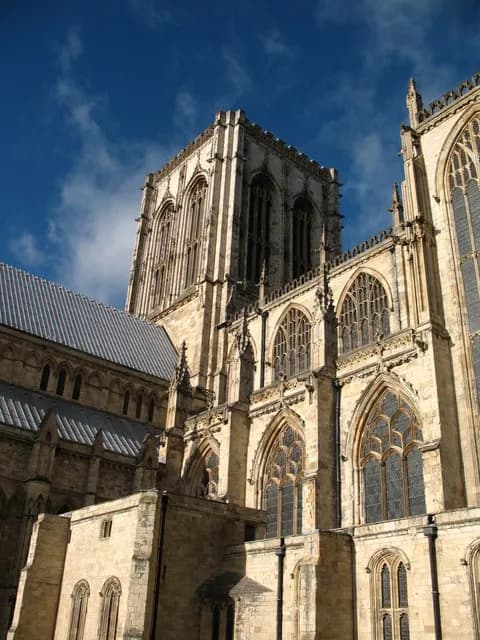
The productions attracted considerable talent. Notable performers include Ian McShane as Lucifer in 1963, David Bradley as Jesus in 1976, and Robson Green in the same role in 1992, when the plays moved to York Theatre Royal. The 2000 Millennium production at York Minster, directed by Gregory Doran and adapted by Mike Poulton, featured Ray Stevenson as Christ and attracted 28,000 audience members over a month-long run. The 2012 Museum Gardens production involved over 1,000 volunteers, including 500 amateur actors in two casts, with Ferdinand Kingsley as Jesus. More recent Minster productions include Phillip Breen's 2016 staging with Philip McGinley as Jesus.
The 2022 Waggon Plays and Beyond
In 2022, the York Mystery Plays Supporters Trust (YMPST) presented waggon plays featuring eight performances over two Sundays, with additional smaller productions at Shambles Market. This community-led approach reflects the trust's mission, formed following the 2012 production, to advance public education in the medieval Mystery Plays. The wagon format returns the tradition to its processional roots, with modern York Guilds reviving the medieval practice of guild sponsorship.
The 2026 Festival
The next full festival is scheduled for Sunday 28 June and Sunday 5 July 2026. Performances will take place across four locations: Minster Refectory Gardens, King's Square, St Sampson's Square, and Dean's Park, with special midsummer performances at Shambles Market. The festival maintains the plays' status as what organisers describe as "one of the city's greatest literary and theatrical traditions" and a "hugely popular part of York's cultural heritage."
What Is Confirmed: The medieval origins of the plays, the 48-pageant structure, the wagon-based performance tradition, and dates of major modern revivals from 1951 onwards are all documented. The 2026 festival dates have been announced.
What Is Unclear: Specific details of the original 12 playing station locations within York and precise attendance figures for some earlier productions are not available in the accessible sources.